What Is Network Security and Why Does It Matter in 2026?

Network security refers to the tools and strategies used to protect a computer network from cyber threats. It covers both hardware and software technologies, and it targets a wide variety of threats. Effective digital security manages access to the network, protects data in transit, and ensures that all connected devices meet security standards.
Every 39 seconds, a cyberattack takes place somewhere in the world. For businesses, governments, and everyday users, Network Security has never been more critical. In 2026, the threat landscape has evolved dramatically, ransomware groups are more organized, AI-powered phishing attacks are more convincing, and the attack surface has expanded with remote work, IoT devices, and cloud infrastructure. Understanding and implementing solid cybersecurity practices is the first and most important step toward protecting your sensitive data.
This guide covers 11 proven Network Security strategies that organizations and individuals can apply right now. Whether you are a small business owner, an IT professional, or someone who simply wants to protect personal data, these practices will significantly reduce your risk exposure. Strengthening your security posture does not require a massive budget, it requires awareness, planning, and consistent execution.
In 2026, global cybercrime is projected to cost the world over $10 trillion annually. Data breaches, insider threats, and supply chain attacks are pushing organizations to rethink how they approach Network Security. The consequences of poor cybersecurity include financial loss, legal liability, reputational damage, and in some sectors, serious public safety risks. Investing in robust Network Security solutions is no longer optional , it is a business survival strategy.
1. Implement a Zero Trust Network Security Architecture

Zero Trust is one of the most transformative shifts in modern Network Security thinking. Businesses adopting Zero Trust should also understand cloud security because modern data, applications, and users often operate across cloud platforms, remote devices, and connected networks. The traditional “trust but verify” model assumed that everyone inside the network was safe. Zero Trust flips that assumption entirely: never trust, always verify. In a Zero Trust architecture model, every user, device, and application must continuously prove that it has the right to access specific resources regardless of where it is located.
To implement Zero Trust effectively, organizations should enforce multi-factor authentication (MFA), microsegment their networks, apply the principle of least privilege, and monitor all traffic continuously. This architecture dramatically limits lateral movement by attackers who may have already breached the perimeter. In 2026, Zero Trust is no longer an advanced concept, it is a security baseline that every modern organization should adopt.
2. Conduct Regular Network Security Audits and Vulnerability Assessments

You cannot protect what you do not understand. A security audit is a comprehensive review of your entire network infrastructure including hardware, software, policies, and user access controls. Regular audits help identify weaknesses before attackers do. Vulnerability assessments take this a step further by actively scanning the network for known exploits, misconfigurations, and outdated software versions.
Best practices include scheduling full audits at least quarterly, using automated scanning tools like Nessus, Qualys, or OpenVAS, and ensuring that findings are prioritized and remediated promptly. Penetration testing, where ethical hackers simulate real attacks adds another layer of assurance. Organizations that conduct regular security evaluations are significantly less likely to suffer a major breach.
3. Use Next-Generation Firewalls for Stronger Network Security

Traditional firewalls were designed to filter traffic based on IP addresses and ports. Today’s threats require far more sophisticated tools. Next-Generation Firewalls (NGFWs) offer deep packet inspection, application awareness, intrusion prevention systems (IPS), and SSL/TLS inspection. These capabilities allow them to detect and block threats that traditional firewalls would miss entirely.
When deploying NGFWs as part of your overall security strategy, ensure they are properly configured with strict default-deny rules, regularly updated with the latest threat intelligence feeds, and integrated with your security information and event management (SIEM) system. NGFWs are a cornerstone of any layered defense-in-depth approach.
4. Encrypt Data Both In Transit and At Rest as a Network Security Priority
Encryption is one of the most fundamental Network Security controls available. Data in transit, information moving between devices, servers, or cloud environments should always be protected using strong protocols such as TLS 1.3. Data at rest stored on servers, databases, or endpoints , must be encrypted using AES-256 or equivalent standards to ensure it cannot be read even if physical access is obtained.
Many organizations overlook encryption for internal traffic, assuming that threats only come from outside. However, insider threats and lateral movement attacks often target unencrypted internal data. A sound security posture encrypts all sensitive data end-to-end, manages encryption keys securely with a dedicated key management service, and audits encryption configurations regularly.
5. Strengthen Network Security Through Multi-Factor Authentication

Weak and stolen credentials are the leading cause of data breaches globally. Multi-factor authentication (MFA) adds a critical layer to your defenses by requiring users to verify their identity through multiple methods something they know (password), something they have (authenticator app or hardware token), or something they are (biometrics). Even if a password is compromised, MFA prevents unauthorized access in most cases. Strong login protection also improves
user experience because secure access systems help users sign in safely while reducing the risk of account misuse.
For maximum Network Security impact, enforce MFA across all accounts including administrative accounts, VPN access, cloud services, and internal applications. Consider moving toward phishing-resistant MFA methods such as FIDO2 hardware keys or passkeys, which are immune to credential-harvesting attacks that trick users into entering codes on fake websites.
6. Deploy Intrusion Detection and Prevention Systems for Proactive Network Security
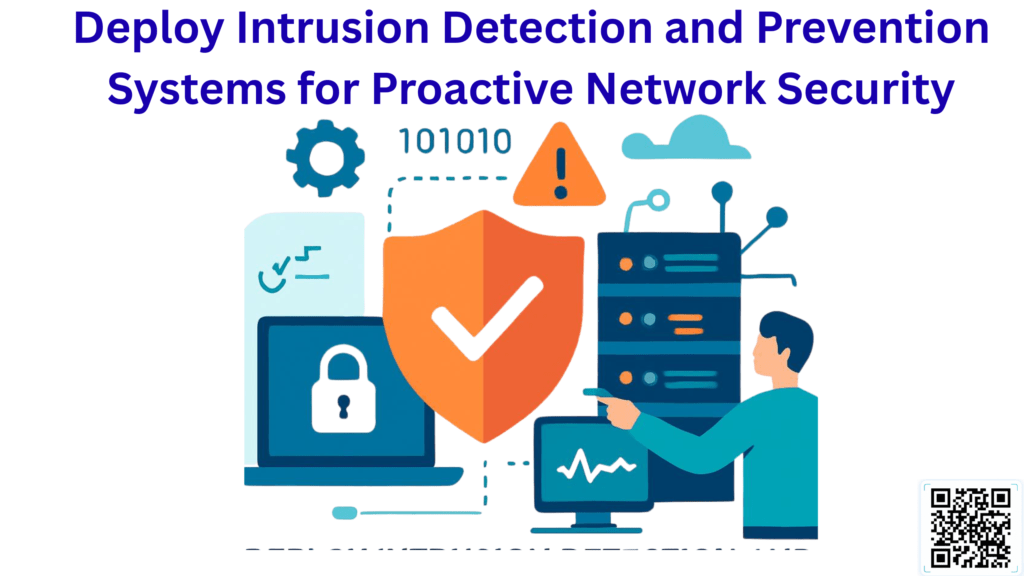
Intrusion Detection Systems (IDS) and Intrusion Prevention Systems (IPS) are essential tools in a mature cybersecurity toolkit. An IDS monitors network traffic for suspicious patterns and alerts administrators to potential threats. An IPS goes further by automatically blocking or quarantining malicious traffic before it can cause damage. Together, they provide real-time visibility and automated defense capabilities.
Modern IDS/IPS solutions use machine learning to detect anomalous behavior flagging unusual data exfiltration, unexpected admin logins, or lateral movement between systems. When integrated into a broader security operations workflow, these tools provide the early warning signals that enable fast incident response. Deploy them at both the network perimeter and on critical internal segments.
7. Segment Your Network to Contain Breaches and Improve Network Security

Network segmentation is the practice of dividing a network into smaller, isolated zones so that a breach in one area does not automatically compromise the entire environment. This is a powerful Network Security control because it limits an attacker’s ability to move laterally after gaining initial access. For example, separating guest Wi-Fi from internal systems, isolating IoT devices, and placing financial systems in their own protected zone all reduce risk dramatically.
Microsegmentation takes this concept further by applying granular Network Security policies down to the individual workload or application level. Tools like software-defined networking (SDN) and next-generation firewalls make microsegmentation practical even in complex environments. The result is a much harder-to-exploit environment where attackers face a series of additional barriers at every step.
8. Keep All Systems Patched to Eliminate Network Security Vulnerabilities
Unpatched software is one of the most common entry points for attackers. When a vulnerability is publicly disclosed, cybercriminals race to exploit it before organizations can apply the fix. A rigorous patch management process is a non-negotiable element of good security hygiene. This includes operating systems, applications, firmware, network devices, and any third-party software in the environment.
Build a structured patch management workflow that prioritizes critical vulnerabilities, tests patches in a staging environment before production deployment, and tracks compliance through automated tools. Automated patch management platforms such as Microsoft Endpoint Configuration Manager or Ansible can significantly reduce the time between patch release and deployment closing the window that attackers exploit. Good Network Security means no system is left behind.
9. Train Employees Your Most Critical Network Security Asset

Technology alone cannot protect your organization. Human error remains the leading cause of successful cyberattacks. Phishing emails, social engineering, weak passwords, and careless handling of sensitive data all create openings that attackers exploit. Ongoing employee training is an essential pillar of effective Network Security that is often underinvested. Every person who touches your network is either a potential vulnerability or a line of defense.
Build a security-aware culture by running regular phishing simulations, offering role-specific security awareness training, and making security policies easy to understand and follow. Celebrate good security behaviors and create clear, blame-free channels for reporting suspicious activity. Organizations with strong security cultures experience significantly fewer successful attacks than those that treat cybersecurity purely as an IT problem.
10. Develop a Network Security Incident Response Plan Before You Need One
Even the strongest cybersecurity defenses can be overcome by a determined attacker. What separates organizations that recover quickly from those that suffer prolonged damage is preparation. A well-documented and regularly tested incident response plan tells your team exactly what to do when a breach occurs, who to notify, how to contain the threat, how to preserve evidence, and how to communicate with stakeholders.
Your Network Security incident response plan should align with established frameworks such as the NIST Cybersecurity Framework or ISO 27035. Run tabletop exercises at least twice a year to test your team’s readiness. Identify and pre-authorize your forensics partners, legal counsel, and communications team so that decisions can be made quickly under pressure. A practiced plan is the difference between a manageable incident and a catastrophic breach. Resilient Network Security includes knowing how to bounce back.
11. Monitor and Log Everything Visibility Is the Foundation of Network Security
You cannot defend against what you cannot see. Comprehensive monitoring and logging is the backbone of a modern Network Security operations capability. Every network event, user login, configuration change, and data transfer should be logged and analyzed. Security Information and Event Management (SIEM) platforms aggregate these logs and use correlation rules and AI-driven analytics to surface potential threats in real time.
Set up centralized log management, ensure that logs are tamper-proof and retained for an appropriate period (typically 12 months or more to meet compliance requirements), and build dashboards that give your Network Security team immediate situational awareness. Pair SIEM with a Security Operations Center (SOC) whether in-house or outsourced so that alerts are investigated and acted upon promptly. In 2026, real-time monitoring is a Network Security best practice that no organization can afford to skip.
Emerging Network Security Trends to Watch in 2026

The cybersecurity landscape is evolving at a pace never seen before. Staying ahead of emerging trends gives you a strategic advantage. Here are several developments that every IT and security leader should be tracking in 2026:
- AI-Powered Threat Detection: Machine learning is now being used on both sides of the battle. Defenders are leveraging AI to detect anomalies faster than any human analyst could. This makes AI-powered threat detection one of the most important technology trends for businesses that want faster response, better monitoring, and stronger protection in 2026. Integrating AI-driven tools into your security technology stack accelerates detection and response times significantly.
- Secure Access Service Edge (SASE): SASE combines networking and Network Security functions into a single cloud-delivered service. It is becoming the go-to architecture for organizations with distributed workforces and hybrid cloud environments.
- Post-Quantum Cryptography: With quantum computing advancing rapidly, organizations must begin planning their transition to quantum-resistant encryption algorithms. This is a long-term Network Security investment that needs to start now.
- Supply Chain Security: Attackers are increasingly targeting third-party vendors to gain access to larger organizations. Rigorous vendor vetting, software bill of materials (SBOM) management, and third-party Network Security assessments are becoming standard practice.
Common Network Security Mistakes to Avoid

Even well-resourced organizations make avoidable security mistakes. Understanding these pitfalls can save you from costly incidents:
- Relying on perimeter security alone: The network perimeter has dissolved. Assuming that firewalls at the edge are sufficient for protecting the network leaves internal systems dangerously exposed.
- Ignoring insider threats: Not all threats come from outside. Disgruntled employees or unintentionally careless staff can cause significant damage. Monitor privileged access and enforce least-privilege policies consistently.
- Failing to test backups: Many organizations discover their backups are incomplete or corrupted only when they need them most. Regularly test your backup and recovery processes as part of your Network Security and business continuity planning.
- Skipping security by design: Security should be built into systems from the ground up, not bolted on afterward. This is why secure web development is important, because websites and applications should be planned with protection, performance, and user safety from the beginning. When deploying new applications or infrastructure, embed Network Security requirements into the design process from day one.
How to Build a Long-Term Network Security Strategy

Implementing individual security controls is valuable, but the most resilient organizations treat security as a continuous, strategic program rather than a checklist. A long-term Network Security strategy should align with your business objectives, be proportional to your risk profile, and evolve as the threat landscape changes. Start by conducting a thorough risk assessment, then prioritize your investments based on the likelihood and potential impact of various threats.
Build a security roadmap that spans 12 to 36 months, with clear milestones and accountability. Establish governance structures such as a security committee or a CISO to ensure that Network Security remains a board-level priority. Measure your progress using maturity models such as the NIST Cybersecurity Framework or CIS Controls, and benchmark your performance against industry peers. Security is a journey, not a destination.
Frequently Asked Questions (FAQs)

1. What are network security best practices?
Network security best practices are strategies, policies, and technologies used to protect networks, devices, and data from cyber threats such as malware, ransomware, phishing attacks, and unauthorized access.
2. Why is network security important in 2026?
As cyberattacks become more sophisticated and organizations rely more on cloud services, remote work, and connected devices, strong network security is essential to protect sensitive information, maintain business continuity, and comply with regulations.
3. What is Multi-Factor Authentication (MFA) and why should I use it?
Multi-Factor Authentication (MFA) adds an extra layer of security by requiring users to verify their identity through multiple methods, such as passwords, mobile apps, or biometric authentication. It significantly reduces the risk of unauthorized access.
4. How often should security patches and software updates be applied?
Critical security patches should be applied as soon as possible, while regular updates should follow a structured patch management schedule. Keeping systems updated helps prevent attackers from exploiting known vulnerabilities.
5. What role does employee cybersecurity training play in network security?
Employees are often the first line of defense against cyber threats. Regular cybersecurity awareness training helps staff recognize phishing emails, social engineering tactics, and other common attack methods.
6. How can businesses protect their networks from ransomware attacks?
Businesses can reduce ransomware risks by implementing regular data backups, using endpoint protection solutions, applying security updates promptly, restricting user privileges, and educating employees about phishing attacks.
7. What is network segmentation and why is it important?
Network segmentation divides a network into smaller sections, limiting access between systems. This helps contain security breaches and prevents attackers from moving freely across the network.
8. Are firewalls still relevant for network security in 2026?
Yes. Modern firewalls remain a critical security layer by monitoring and controlling network traffic, blocking unauthorized access, and helping organizations enforce security policies.
Conclusion: Make Network Security a 2026 Priority
The 11 proven practices outlined in this guide, Zero Trust architecture, regular audits, next-generation firewalls, encryption, multi-factor authentication, intrusion detection, network segmentation, patch management, employee training, incident response planning, and continuous monitoring form a comprehensive foundation for strong Network Security in 2026 and beyond.
Cyber threats are not slowing down. They are growing in sophistication, frequency, and impact. The organizations that will thrive are those that treat Network Security as a strategic investment rather than a reactive cost center. Start today: assess your current posture, close the most critical gaps, and build a culture where security is everyone’s responsibility. Strong Network Security is not just about protecting data it is about protecting trust, reputation, and the future of your organization.